
Struck in a San Diego Crosswalk: Pedestrian Rights, Claims Against the City, and Why the Investigation Cannot Wait
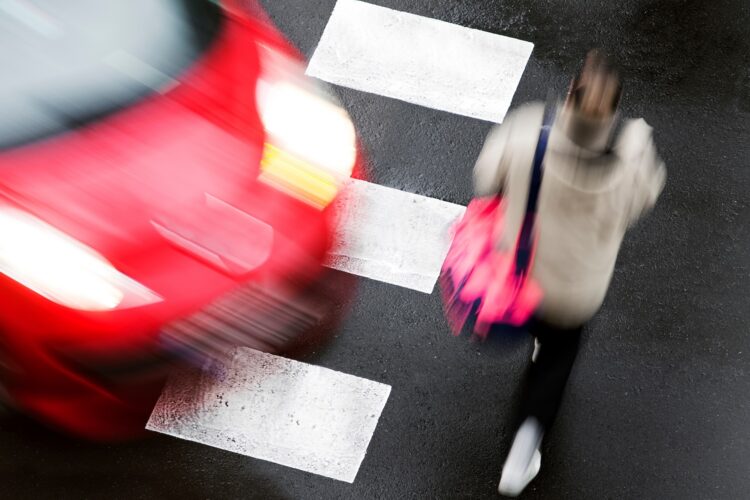
San Diego Crosswalk Accident
Around 5 a.m. on a recent Friday, a 34-year-old woman was crossing Euclid Avenue at Federal Boulevard in San Diego’s Webster neighborhood when a southbound 2004 Mazda struck her. According to the San Diego Police Department, as reported by CBS 8, she was in the crosswalk. Paramedics rushed her to the hospital with life-threatening injuries: a skull fracture, a brain contusion, a torn carotid artery, and liver damage. Police said intoxication was not a factor and that it was “not immediately clear who was at fault.” Learn more about the San Diego crosswalk accident.
By Pajman Jassim, San Diego’s Trusted Personal Injury Lawyer
Our thoughts are with this woman and her family. We do not represent her, and we know nothing about the collision beyond what SDPD has released. But the story is a familiar one in our practice, and it raises the questions every family in this situation eventually has to answer: How common is this? Who is responsible? And what has to happen, and how quickly, to find out?
Pedestrian Collisions Are Common, and They Are Deadly
Nothing protects a person on foot. A driver in a collision has a steel frame, airbags, and a seat belt. A pedestrian has none of that, which is why a crash that would leave a motorist with a sore neck leaves a pedestrian with a fractured skull. Nationally, drivers killed more than 7,000 pedestrians in 2024 according to the Governors Highway Safety Association, and California consistently leads the country, with roughly 1,100 pedestrian deaths in 2023 and more than 900 in 2024 by preliminary count. San Diego County records dozens of pedestrian deaths every year, and many times that number of serious injuries.
Two patterns in that data are worth noting because they describe the Euclid and Federal collision almost exactly. The single strongest predictor of whether a pedestrian survives is the vehicle’s speed at impact, and the majority of pedestrian fatalities happen after dark. A crosswalk on a wide urban arterial before sunrise is, statistically, one of the most dangerous places a person can be. The injuries reported here, a traumatic brain injury, a torn carotid artery with its attendant risk of stroke, and internal organ damage, are the injuries that define a lifetime-of-care case, not a soft-tissue claim.
Pedestrians Have the Right-of-Way, and They Also Have Duties
When police say fault is unclear, they are describing what a patrol officer can determine at a dark crash scene, not what the law provides. California’s crosswalk law is specific, and it cuts in both directions.
- Drivers must yield. Vehicle Code section 21950(a) requires a driver to yield the right-of-way to a pedestrian crossing within any marked crosswalk, or within an unmarked crosswalk at an intersection.
- Drivers must slow down and use all due care. Section 21950(c) requires a driver approaching a pedestrian in a crosswalk to exercise all due care and reduce speed or take any other action necessary to safeguard the pedestrian. The basic speed law, section 22350, independently prohibits driving faster than is reasonable for the conditions, and “reasonable” at 5 a.m. in the dark is not what it is at noon.
- Pedestrians must not dart into traffic. Section 21950(b) provides that a pedestrian may not suddenly leave a curb or other place of safety and walk or run into the path of a vehicle that is so close as to constitute an immediate hazard. Having the right-of-way does not mean a pedestrian can step in front of a car that cannot stop.
- But the pedestrian’s duty does not erase the driver’s. Section 21950(d) states expressly that subdivision (b) does not relieve a driver of the duty to exercise due care for the safety of any pedestrian in a crosswalk.
Because California follows pure comparative fault under Li v. Yellow Cab Co. (1975) 13 Cal.3d 804, these duties are weighed against each other rather than treated as an all-or-nothing question. A pedestrian who bears some share of responsibility still recovers, with damages reduced by her percentage of fault. In a case with injuries this serious, the difference between 0% and 30% pedestrian fault is measured in millions of dollars, which is why the word “running” in the police summary will become the centerpiece of the insurer’s defense. Whether it should be depends on facts the summary does not contain: the Mazda’s speed, where the driver was looking, whether a phone was in use, how far away the pedestrian was when she first became visible, and how much time the driver had to react.
The “Blame the Pedestrian” Playbook
Long before fault is actually determined, the driver’s insurance company will have a theory, and it will be that the pedestrian caused her own injuries. We have seen the same arguments in nearly every pedestrian case we have handled, often delivered to the family while the injured person is still in the ICU:
- “She wasn’t paying attention.” The insurer will suggest the pedestrian was distracted, talking to a companion, wearing headphones, or simply not looking, without any evidence of what she was actually doing.
- “She darted into traffic.” Any suggestion of movement, including the single word “running” in a police summary, becomes a claim that the pedestrian left a place of safety and gave the driver no chance to stop.
- “She was looking at her phone.” This has become the favorite. If a phone was anywhere near the pedestrian, the insurer will argue she was staring at it instead of the road.
Here is what those arguments leave out. The driver has a duty to see what is there to be seen, and a person in a marked crosswalk is exactly what a driver approaching that intersection is required to be watching for. And when the pedestrian is crossing on a green light or a WALK signal, the phone argument collapses entirely. Under Vehicle Code section 21456, a pedestrian facing a WALK signal may proceed across the roadway in the direction of the signal, and drivers must yield to her. There is no California law that prohibits a pedestrian from looking at a phone while crossing the street. Not looking at a phone is good practice, and we recommend it, but it is not a legal duty, and a driver who runs into a person lawfully crossing with the signal cannot excuse it by pointing to what was in her hand. The driver was required to yield whether she was looking at her phone, at the sky, or at the car that hit her.
The “distracted pedestrian” narrative works only when no one pushes back with evidence. Signal timing records establish who had the right-of-way. Video and body-camera footage establish where the pedestrian was and how she was moving. The driver’s own phone records establish where his attention was. In our experience, the insurer that is quickest to accuse the pedestrian of looking at her phone is often the one whose driver was looking at his.
When the Roadway Is Part of the Problem: Claims Against Public Entities
Not every pedestrian collision is only about the driver. Wide arterials, poorly lit crossings, faded crosswalk markings, signal timing that does not give pedestrians enough time, obstructed sight lines, and intersections with a history of prior collisions are all conditions that the public entity responsible for the roadway may be answerable for. Under Government Code section 835, a public entity is liable for injury caused by a dangerous condition of its property if it created the condition or had notice of it in time to fix it.
These claims are real, and they are also demanding. Public entities assert design immunity under Government Code section 830.6 and argue that a condition was not “dangerous” because the roadway was used safely by others. Proving the claim requires collision history, traffic engineering analysis, maintenance and lighting records, and expert testimony, none of which a family can assemble on its own.
The claim also has a trap built into it. Under Government Code section 911.2, a written claim for injury generally must be presented to the public entity within six months of the date of injury, before any lawsuit against the entity can be filed. A family that waits for the police investigation to conclude, or that spends months negotiating with the driver’s insurer, can lose the claim against the City entirely without ever knowing it existed. We evaluate the roadway in every pedestrian case, and we do it at the outset, because the deadline does not wait for the medical picture to stabilize.
|
Why Hiring a Lawyer Immediately Matters: Most of the Evidence Is Locked | San Diego Crosswalk Accident
Families are often told to focus on recovery and worry about the legal case later. That advice is well-intentioned and, in a serious pedestrian case, wrong. The evidence that decides fault begins disappearing within days, and most of it is not available to an injured person, or to her family, or even to her lawyer, until a lawsuit is on file.
A lawsuit is not a declaration of war. It is the legal mechanism that unlocks the tools of investigation:
- Subpoena power. Only a party to a pending action can issue subpoenas under the Civil Discovery Act. That is how we obtain the driver’s cell phone records for the minutes before impact, surveillance footage from businesses and residences that will not release it voluntarily, City signal timing and streetlight maintenance records, and the intersection’s collision history.
- Deposition power. A deposition puts the driver under oath, on the record, answering our questions about speed, attention, headlights, and what he saw and when. Witnesses, responding officers, and paramedics can be deposed while their memories are fresh rather than years later. None of this is available before suit is filed.
- Police body-worn camera footage. SDPD officers who respond to a collision record the aftermath: the position of the vehicle and debris, the lighting conditions as they actually were, the driver’s first unrehearsed account of what happened, and witness statements given before anyone has spoken to an insurance company. Police departments routinely decline to release this footage while an investigation is open, relying on the investigatory-records exemption to the Public Records Act. A subpoena issued in a filed lawsuit is the reliable way to obtain it, and to obtain it before retention periods expire.
- Vehicle preservation. Many vehicles store pre-impact speed and braking data in an event data recorder. Whether a given 2004 model retains usable data is a question for an expert, but the question cannot be answered if the car has been repaired, sold, or sent to salvage. A preservation demand, backed by the threat of sanctions in a pending case, is what keeps the vehicle intact.
|
This is why our practice in serious injury cases is to file suit early, often within weeks of being retained. Filing early is not about being aggressive for its own sake. It is the only way to secure the evidence while it still exists, and it signals to the driver, the insurer, and any public entity that the case will be built for a jury rather than negotiated down from a police summary. That approach is how we recently resolved a crosswalk case for $4,000,000 on behalf of a pedestrian the defense initially blamed for the collision.
|
What Families Should Do Now | San Diego Crosswalk Accident
- Do not give a recorded statement to the driver’s insurer, and do not sign anything. Their job is to find the words that reduce what they owe.
- Write down what you know about the location, time, weather, lighting, and the names of anyone who was present or has called with information.
- Identify cameras. Note every business, residence, or traffic camera with a view of the intersection. Private systems commonly overwrite footage within days.
- Preserve everything from the hospital: records, imaging, and bills. The ICU records from the first days are often the most powerful evidence of how serious the injuries were.
- Consult a trial lawyer now, not after the investigation concludes. The six-month public entity deadline and the evidence retention clocks are already running.
We Prepare Every Pedestrian Case for Trial From Day One
Jassim Law is a San Diego trial firm. We take fewer cases than the billboard firms so that every one of them is prepared as if it will be decided by a jury in San Diego Superior Court, and we have been doing this work in this community for more than two decades. We do not accept a police report’s preliminary statement that fault is unclear as the last word. We treat it as the first. The results described above, a $4,000,000 crosswalk settlement, a $500,000 policy-limits tender secured with market video, and a $400,000 recovery on a $250,000 policy, are the product of that approach.
San Diego Crosswalk Accident
If you or a family member has been seriously injured as a pedestrian in San Diego, contact Jassim Law for a free, confidential consultation. The investigation that wins your case starts the day you call. Serving San Diego and Southern California.
Frequently Asked Questions | San Diego Crosswalk Accident
Source: CBS 8, reporting statements of San Diego Police Department Officer David O’Brien. Jassim Law does not represent any party to the collision described above. This article is attorney advertising and is provided for general informational purposes only; it is not legal advice and does not create an attorney-client relationship.
Attorneys
JASSIM LAW
- Top 10.00 Avvo-rated attorney
- San Diego’s Best Attorneys
- Super Lawyers
- Member of San Diego, Los Angeles and Orange county bar associations